

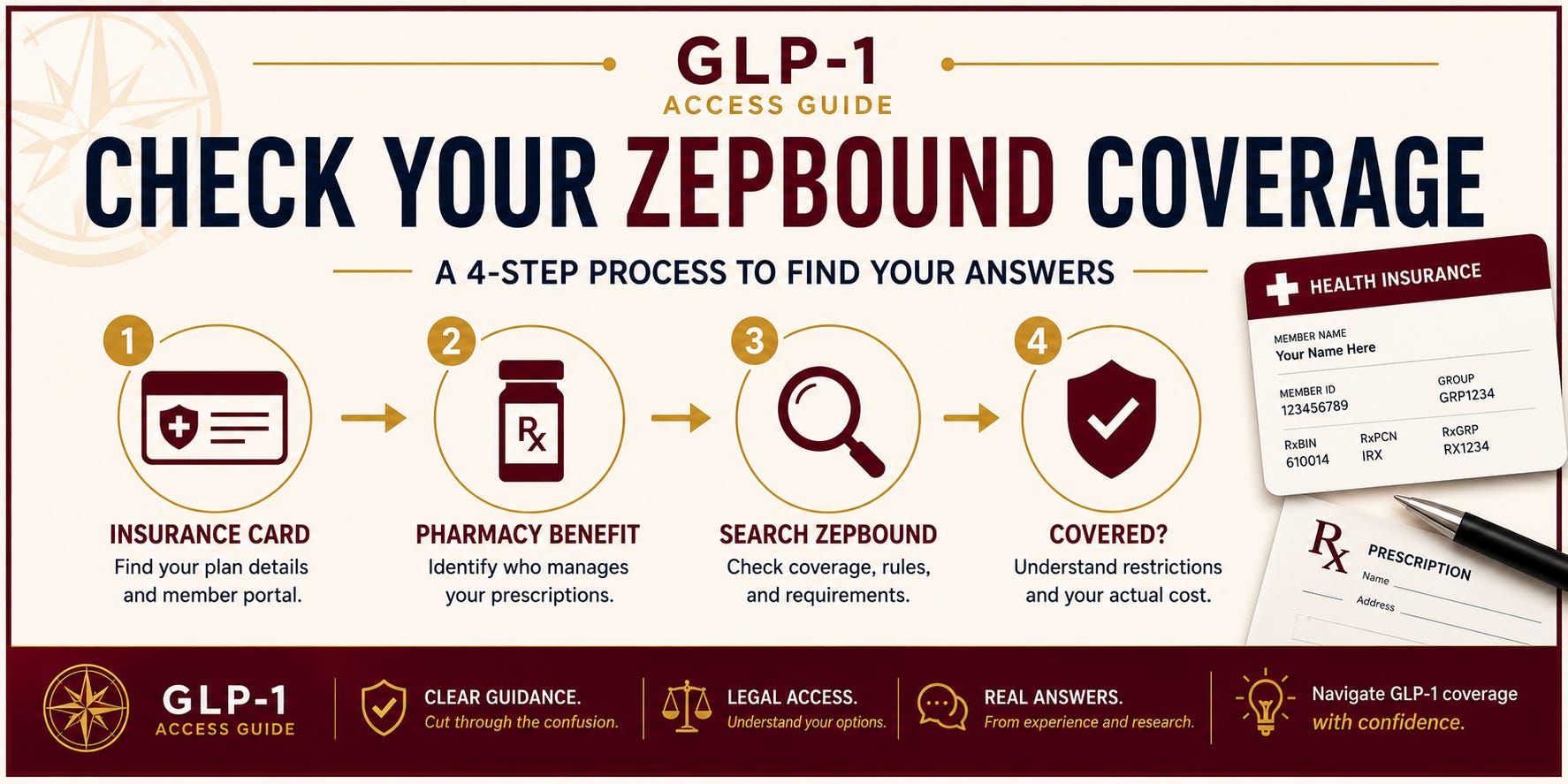
If you’ve ever Googled “Does Aetna cover Zepbound?” or “Does Blue Cross cover Zepbound?”, you’ve probably noticed that getting a straight answer is surprisingly difficult.
There’s a reason for that.
“Does Aetna cover Zepbound?” is actually the wrong question.
I didn’t fully appreciate this until I started digging into how GLP-1 coverage actually works.
Two people can both have Aetna. One might get Zepbound covered after a prior authorization. The other might have a plan that specifically excludes weight-loss medications.
Same insurance company. Same medication. Completely different answer.
That’s because the logo on your insurance card is only one piece of the puzzle.
Your employer or plan sponsor can have a say in what benefits are included. Your prescription benefits may be managed by an entirely different company. Your specific formulary determines which drugs are covered. And even when Zepbound is covered, there may be prior authorization or other requirements before your insurance company will pay for it.
It sounds complicated.
And, frankly, it is.
But figuring out your own coverage is usually much easier than understanding the entire system.
Give yourself about 10 minutes, grab your insurance card, and let’s figure it out.
Step 1: Figure Out Who Actually Handles Your Prescriptions
This is the first thing I would check, because it’s something a lot of people don’t realize.
The company providing your medical insurance isn’t necessarily the company making decisions about your prescription benefit.
You might have Aetna insurance, for example, while your pharmacy benefit runs through CVS Caremark.
Other major pharmacy benefit managers, or PBMs, include:
· CVS Caremark
· Express Scripts
· Optum Rx
· CarelonRx
Look at your insurance card. You may see RxBIN, RxPCN or RxGRP, along with information about your prescription benefit.
You can also log into your insurance account and look for something like Pharmacy, Prescriptions, Drug Coverage or Pharmacy Benefits.
This matters because your pharmacy-benefit portal may be the fastest place to get the answer we’re looking for.
CVS Caremark, for example, has a Check Drug Cost & Coverage tool. Express Scripts has a Price a Medication tool that can show whether a medication is covered and what it may cost under your plan. Optum Rx offers similar member-specific drug coverage and pricing tools.
The important distinction here is member-specific.
We’re not trying to figure out what CVS Caremark covers in general.
We’re trying to figure out what your plan covers.
Step 2: Search for Zepbound
Once you’re logged into the right portal, search for:
Zepbound
Not just tirzepatide.
Zepbound and Mounjaro contain the same active ingredient, tirzepatide, but they’re approved for different indications and your insurance can treat them very differently.
We’re specifically trying to answer:
Does my plan cover Zepbound for weight management?
Now pay attention to exactly what comes back.
You might see:
· Covered
· Prior Authorization
· Step Therapy
· Quantity Limit
· Non-formulary
· Not Covered
· Excluded
Those aren’t all different ways of saying “no.”
And understanding the difference can save you a lot of frustration.
Step 3: Figure Out What Your Answer Actually Means
This is probably the most important part of the whole process.
Covered
Great.
But don’t celebrate quite yet.
Keep reading to see whether there are any additional requirements and check what your actual out-of-pocket cost will be.
Prior Authorization — PA
This does not necessarily mean your insurance denied Zepbound.
It means your insurance company wants your provider to demonstrate that you meet its coverage requirements before it agrees to pay for it.
Think:
“Show us that this patient qualifies.”
The exact criteria vary by plan.
Step Therapy — ST
Your insurance may require you to try another treatment first before it will cover Zepbound.
Again, that’s different from simply saying Zepbound isn’t covered.
Quantity Limit — QL
Your plan limits how much medication it will cover within a certain period.
Non-formulary
Zepbound isn’t on your plan’s preferred drug list.
That isn’t necessarily the end of the road either. Some plans have a formulary-exception process that your provider can pursue.
Excluded
This is the one I really want people to understand.
There’s a massive difference between:
“Zepbound requires prior authorization.”
and
“Weight-loss medications are excluded from your plan.”
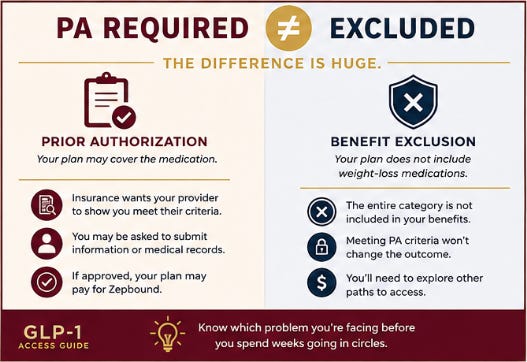
With a prior authorization, the insurance company is essentially saying:
“We may pay for this if you meet our criteria.”
With a benefit exclusion, they’re saying:
“Your plan doesn’t include this category of treatment.”
Those are two completely different problems.
If your employer-sponsored plan excludes anti-obesity medications, repeatedly submitting the same prior authorization isn’t necessarily going to fix it.
You first need to understand whether you’re fighting a clinical-criteria problem or a benefit-design problem.
That distinction alone is worth figuring out before you spend weeks going in circles.
Step 4: If You Need a Prior Authorization, Find the Actual Requirements
If your portal says PA required, don’t stop there.
Your next question should be:
“Okay. What exactly do I need to qualify?”
This is where things start getting interesting.
Insurance companies publish clinical coverage policies explaining their authorization criteria.
UnitedHealthcare, for example, publishes criteria specifically for plans with weight-loss/appetite-suppression medication coverage.
That wording matters.
The clinical criteria only become useful once you’ve established that your plan actually includes the benefit.
Cigna publishes GLP-1 weight-loss prior-authorization criteria as well, while also making clear that the member’s actual benefit-plan documents ultimately control coverage.
Aetna similarly publishes clinical criteria for weight-management medications, while separately explaining to employers that GLP-1 weight-management coverage can be included or excluded from their benefit design.
There’s a lesson buried in all of this:
Being medically eligible for Zepbound does not automatically mean your insurance plan has to cover Zepbound.
Those are separate questions.
First:
Does my plan include the benefit?
Then:
Do I meet the requirements for that benefit?
Step 5: Blue Cross Is Its Own Special Kind of Confusing
If you have Blue Cross Blue Shield, there’s another wrinkle.
“Blue Cross Blue Shield” isn’t one giant insurance company administering everyone’s benefits from one place.
The Blue Cross Blue Shield Association is made up of independent, locally operated BCBS companies.
Depending on where you live and who provides your insurance, you might be dealing with Anthem, Health Care Service Corporation, Highmark or another BCBS company.
That means Googling:
“Does Blue Cross cover Zepbound?”
isn’t going to tell you much.
You need to identify the actual BCBS company administering your plan and then check your specific formulary and pharmacy benefit.
Your insurance card is the best place to start.
Step 6: Now Find Out What It’s Actually Going to Cost You
Here’s another insurance lesson I learned quickly:
“Covered” doesn’t mean “cheap.”
You could discover that Zepbound is technically covered and still get hit with a surprisingly large bill.
Look for your estimated out-of-pocket cost.
Depending on your plan, you may be dealing with a:
Copay — A fixed dollar amount.
Coinsurance — You pay a percentage of the negotiated price.
Deductible — You may be responsible for a larger portion of the cost until you’ve met your deductible.
This is another reason I prefer the logged-in member tools whenever possible.
Generic internet pricing can tell you roughly what a medication costs.
Your insurance portal can tell you something much more useful:
What might it cost you?
Step 7: If You’re Still Confused, Call the Number on Your Card
Sometimes the website simply doesn’t give you a clear enough answer.
Fine.
Call them.
But don’t just ask:
“Do you cover Zepbound?”
I would ask these questions instead:
Is Zepbound covered under my specific pharmacy benefit for chronic weight management?
Is it formulary or non-formulary?
Does it require prior authorization?
What are the prior-authorization criteria?
Is step therapy required?
Are anti-obesity or weight-loss medications excluded from my plan?
If Zepbound isn’t covered, which anti-obesity medications are preferred?
What would my estimated out-of-pocket cost be if Zepbound is approved?
Who administers my pharmacy benefit?
Where can I find the written coverage policy or formulary for my specific plan?
Write the answers down.
By the time you hang up, you should know exactly which problem you’re trying to solve.
You Should Now Be in One of Four Buckets
After all of that, your situation should look something like this:
1. Zepbound Is Covered
Excellent.
Figure out your cost, make sure your pharmacy is in network and move forward with your provider.
2. Zepbound Is Covered, but Requires Prior Authorization
Also potentially good news.
Now you need to understand the criteria and work with your provider to submit the required information.
PA required is not the same thing as denied.
3. Zepbound Isn’t on the Formulary
Ask which weight-management medications are preferred and whether your plan allows formulary exceptions.
There may still be a path forward.
4. Weight-Loss Medications Are Excluded
This is the frustrating one.
But at least now you know what you’re dealing with.
Instead of wasting time repeatedly trying to satisfy a PA requirement that isn’t the real problem, you can start looking at the paths that actually apply to a benefit exclusion: appeals or exceptions where available, employer benefits, alternative covered treatments, manufacturer programs and legitimate cash-pay options.
Those deserve their own guides.
And we’ll get into them.
The 60-Second Version
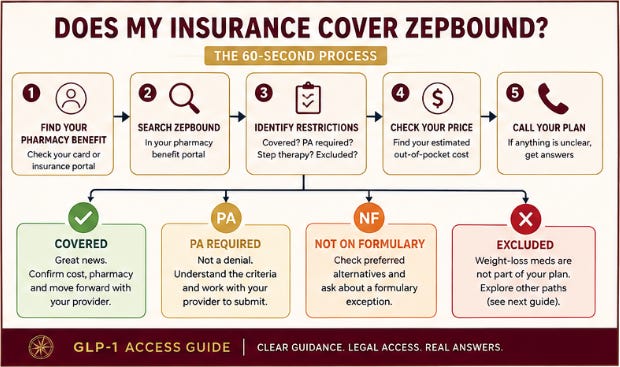
If you don’t remember anything else from this article, remember this:
Don’t ask, “Does my insurance company cover Zepbound?”
Ask:
“Does my specific pharmacy benefit cover Zepbound for weight management?”
Then:
Find your pharmacy benefit → Search Zepbound → Identify restrictions → Find the PA requirements → Check your price → Call your plan if anything is unclear.
That’s the process.
Insurance makes this stuff unnecessarily difficult to understand.
My goal with GLP-1 Access Guide is to make legally accessing GLP-1s a little less ridiculous.
What If My Plan Excludes Weight-Loss Medications?
That’s the frustrating one — and it’s also where things get more complicated.
A benefit exclusion doesn’t necessarily mean you’ve exhausted every option.
Depending on your situation, there may be an appeal or exception process, employer-level options, manufacturer programs, alternative covered medications or legitimate cash-pay routes worth exploring.
That’s what I’m digging into next.
If you’re trying to navigate GLP-1 access without wandering through insurance fine print, telehealth marketing and questionable sourcing advice, subscribe to GLP-1 Access Guide.
I’ll send you the next guide when it’s published.
And if you’ve already fought through this process yourself, I’d really like to hear what happened.
Who is your insurer? Who manages your pharmacy benefit? Was Zepbound covered, PA-required, non-formulary or completely excluded?
Drop your experience in the comments.
The more real-world experiences we collect, the easier it becomes to see where people are getting stuck — and those are exactly the problems I want to investigate next.
Coverage policies, formularies and benefit designs change regularly. This guide was researched using insurer and pharmacy-benefit information available in August 2026. Always confirm current coverage directly with your specific health plan. This guide is educational and isn’t medical, insurance or legal advice.