

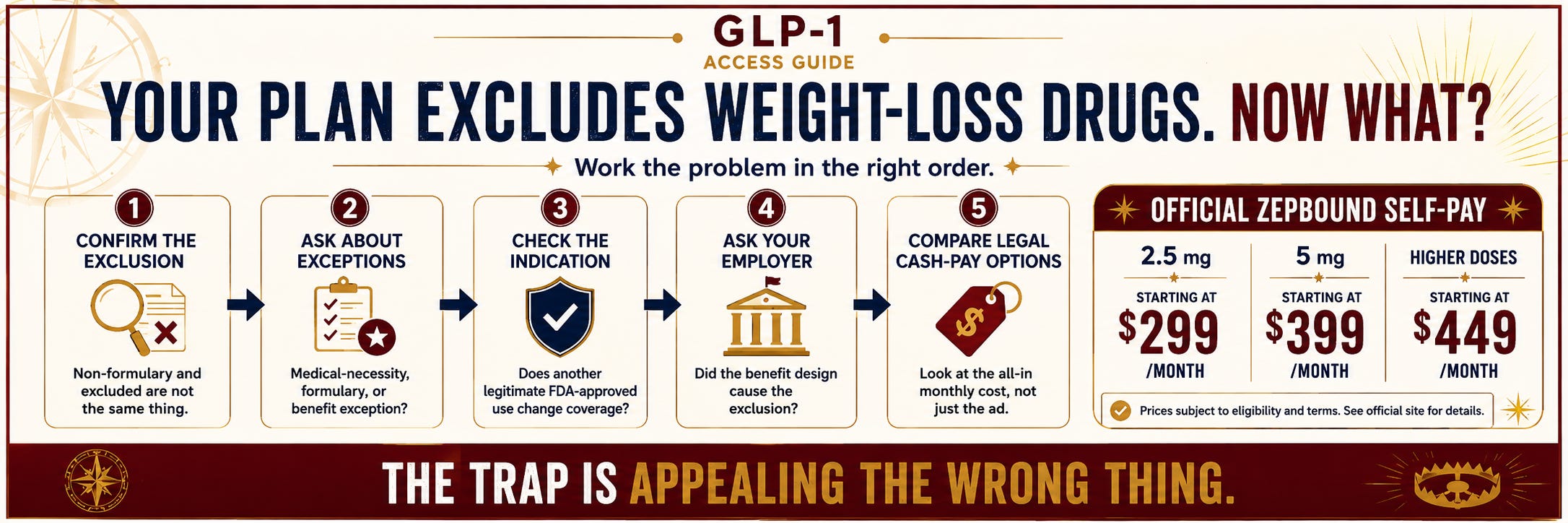
The first instinct is to appeal it.
The problem is that you may be appealing the wrong thing.
If Zepbound was denied because your insurance company says you didn’t meet its prior-authorization requirements, an appeal may make perfect sense.
But if your plan simply excludes weight-loss medications, that’s a different problem entirely.
You can qualify medically.
Your doctor can believe the treatment is appropriate.
The medication can be FDA-approved for exactly the condition being treated.
And your health plan can still say:
That benefit isn’t included.
No amount of perfectly completed prior-authorization paperwork can create a benefit that doesn’t exist.
So before doing anything else, we need to figure out what actually happened.
First: What Was Actually Denied?
“Not covered” is frustratingly vague.
It could mean:
· Zepbound requires prior authorization.
· You didn’t meet the PA criteria.
· Step therapy is required.
· Zepbound is non-formulary.
· Your plan covers other obesity medications, but not Zepbound.
· Or your plan excludes anti-obesity medications altogether.
Those are different things.
And they don’t have the same solution.
Call the number on your insurance card and ask:
“Does my plan specifically exclude anti-obesity medications as a benefit, or is Zepbound simply non-formulary?”
Then:
“Is there a formulary exception, medical-necessity exception or other appeal process available under my specific plan?”
If there is, get the criteria.
If there isn’t, get that answer too.
There’s no sense spending six weeks appealing a PA when the PA was never really the problem.
One More Question: What Indication Is Being Treated?
This is another detail worth checking.
Zepbound isn’t FDA-approved only for weight management. It is also approved for moderate-to-severe obstructive sleep apnea in adults with obesity.
That does not mean finding another diagnosis to get around an exclusion.
It means the indication matters.
If another FDA-approved indication legitimately applies, ask how your plan covers the medication for that indication.
A weight-loss exclusion and coverage for another approved use are separate questions.
Again:
Find out what was actually denied.
This Isn’t Just an Insurance Problem
Here is where the numbers start to make the access problem difficult to ignore.
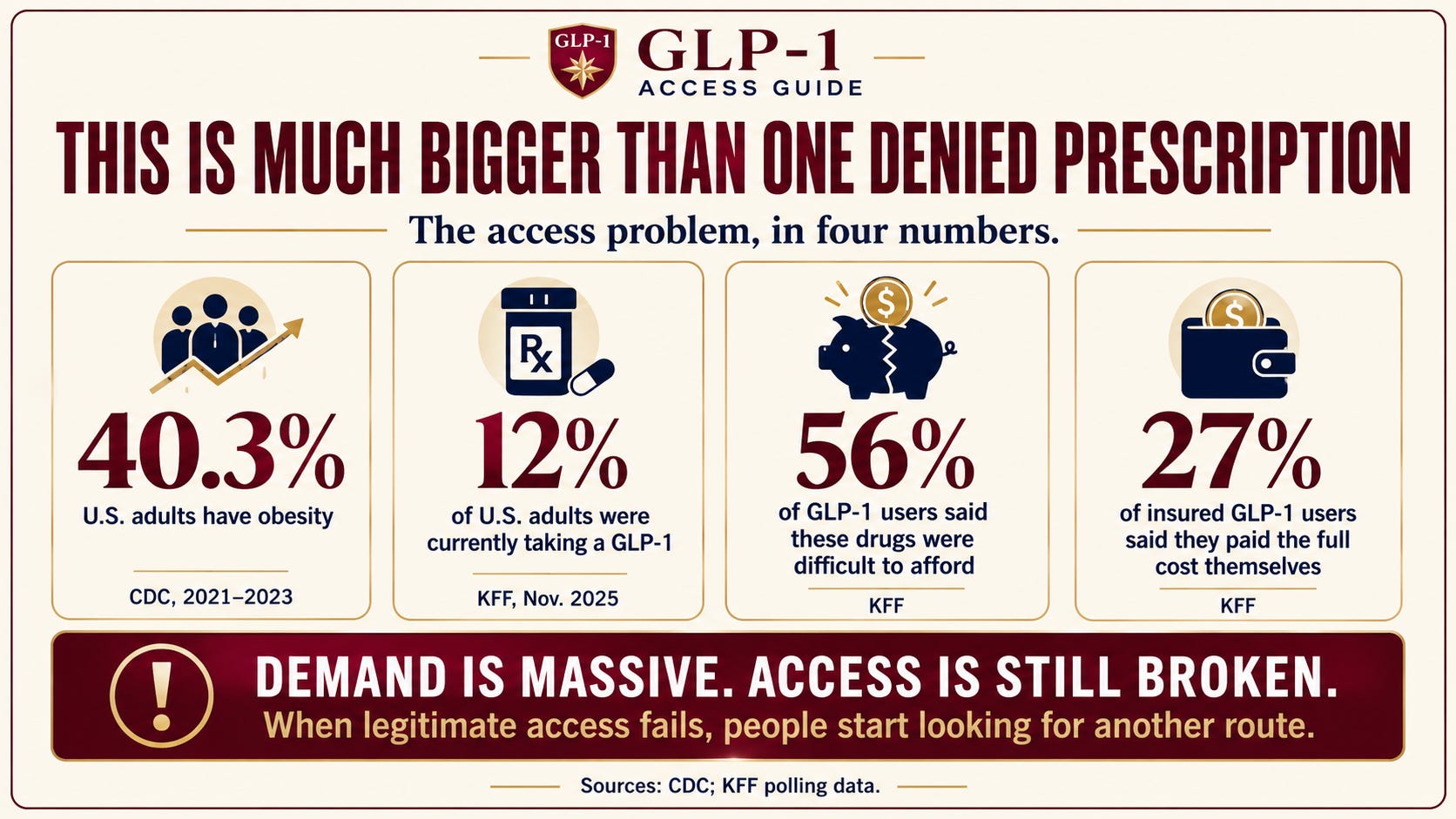
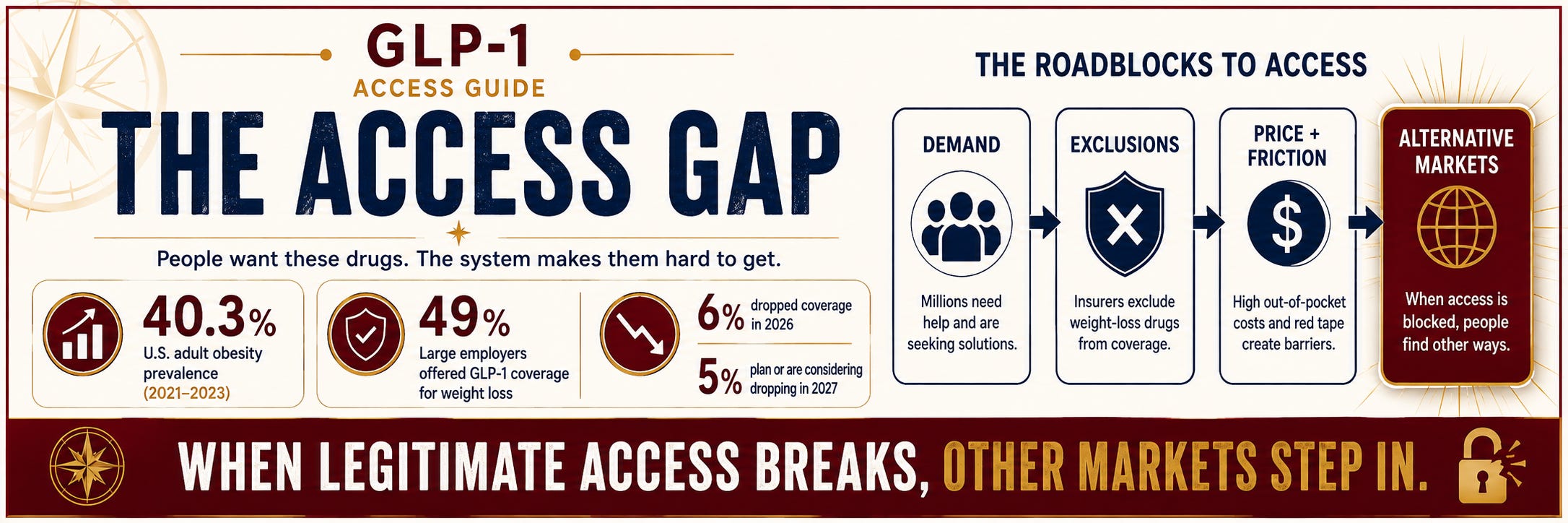
According to the CDC, 40.3% of U.S. adults have obesity.
Not overweight.
Obesity.
Meanwhile, GLP-1 use has exploded.
By November 2025, KFF found that:
12% of American adults were currently taking a GLP-1 medication.
18% had taken one at some point.
Among people who said they’d been diagnosed with overweight or obesity during the previous five years, 23% were currently taking one.
This is not a niche market anymore.
But here’s the number I find more interesting:
56% of GLP-1 users said these medications were difficult to afford.
Even among people with health insurance, that number was 55%.
And 27% of insured GLP-1 users told KFF they had paid the entire cost themselves.
Think about that for a second.
We have massive demand for a class of medications being used by roughly one in eight American adults, aimed in part at a disease affecting roughly four in ten adults…
and more than half of the people actually using them say affordability is difficult.
That’s an access problem.
Your Employer May Be Part of the Answer
This was one of the more surprising things I learned when I started digging into GLP-1 coverage.
You see Aetna or Blue Cross on your insurance card, so naturally you assume the insurer decided whether Zepbound gets covered.
It isn’t always that simple.
With many employer-sponsored plans, the employer or plan sponsor has a role in determining whether weight-management drug coverage is included in the benefit design.
That’s how two people can both say:
“I have Aetna.”
and get completely different answers when they search for Zepbound.
One plan bought the benefit.
Another didn’t.
And you can see why employers are struggling with the decision.
A 2026 Business Group on Health survey found that 67% of participating large employers currently covered GLP-1 medications for weight management.
But nearly eight in ten said GLP-1 use was contributing to higher company health-care costs.
Of the employers currently providing weight-management GLP-1 coverage, only 72% said they were likely to continue doing so in 2027, while 10% said they likely would not.
That’s the tension in one set of numbers.
Employees want the medications.
Employers are watching utilization grow.
And somebody has to pay the bill.
So if your employer-sponsored plan truly excludes obesity medications, I would ask HR or your benefits department:
Does our health plan specifically exclude FDA-approved anti-obesity medications?
Was that exclusion part of our employer’s benefit design?
Is GLP-1 coverage reconsidered during annual benefits planning?
Is there a process for employees to provide feedback when benefits are reviewed?
One employee isn’t going to rewrite a company’s health plan.
But somebody made the decision.
It’s worth understanding where it came from.
Okay. The Benefit Really Isn’t There.
Let’s say you’ve done all of that.
It’s a real exclusion.
There’s no useful exception.
Another covered indication doesn’t apply.
Your employer isn’t changing the benefit tomorrow.
Now what?
This is where the legal access picture has changed considerably.
For years, the cash-pay conversation around drugs like Zepbound started with a number north of $1,000.
For many people, that made the decision for them.
Today, Lilly’s self-pay program looks very different.
Through the Zepbound Self Pay Journey Program, Lilly currently advertises:
2.5 mg starting dose — $299/month
5 mg — $399/month
7.5 mg through 15 mg — $449/month for eligible patients who meet the program’s refill requirements
Outside the Journey Program, regular self-pay prices for the higher doses can be substantially higher, so the terms matter.
Is $449 cheap?
No.
Let’s not pretend it is.
For someone maintaining treatment for an entire year, $449 every month is still more than $5,000.
But compared with the old four-figure monthly cash-pay problem, it changes the equation considerably.
And I think Lilly deserves credit for that.
This is exactly the kind of move that starts attacking the access problem itself.
The Grey Market Signal
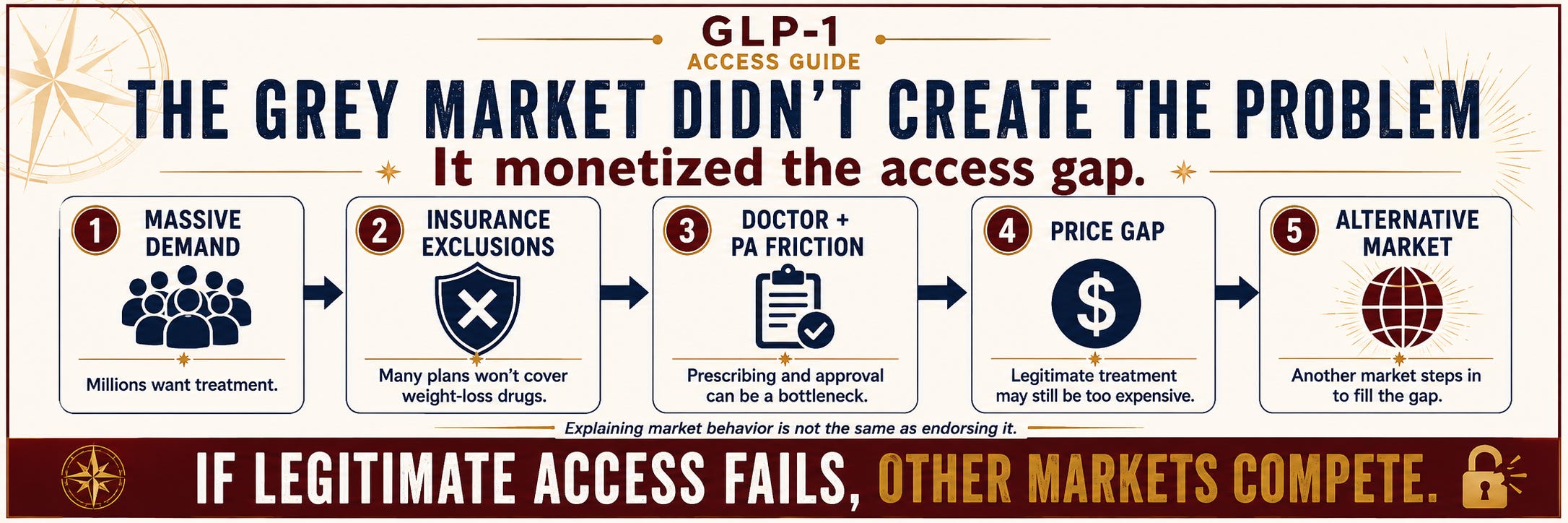
The grey market is a signal.
It tells us people are looking for an ally in this space.
They want these medications, then run into insurance exclusions, PA denials, reluctant prescribers, long waits and prices they can’t sustain.
Eventually, some look elsewhere.
The grey market saw that friction and said:
There’s money to be made in the gap.
I see the same gap and ask:
How do we close it?
How do we help people get genuine Zepbound, Mounjaro, Wegovy or Ozempic through the legitimate system?
And to be clear, I’m not anti-pharma.
Lilly and Novo Nordisk created extraordinary drugs, and they deserve to be rewarded for it.
In my opinion, the best way to do that is to get the genuine product into the hands of as many eligible patients as possible, at a price and through an access path they can sustain.
That’s why I think the grey-market fight sometimes gets the order backwards.
Enforcement matters.
But if legitimate access is still expensive, slow and frustrating, the incentive remains.
Don’t just make the grey market harder to use.
Make the legitimate market easier to choose.
Because the grey market isn’t the problem. It is a risky solution to the problem, itself.
My mission is to do the legwork and help people find the clearest, safest path to legitimate GLP-1 access.
If you’re trying to navigate GLP-1 access without sorting through insurance fine print, affiliate-driven rankings and questionable sourcing advice, subscribe to GLP-1 Access Guide.
Where We’re Going Next
Which leaves us with what I think is one of the most important questions in this entire project:
How cheap can you actually get a GLP-1 legally?
Not the advertised number.
Not the “starting at” price.
Not a $99 telehealth membership advertised in huge letters while the medication cost sits somewhere in the fine print.
I want the real number.
Medication.
Provider.
Membership.
Shipping.
Labs.
Dose increases.
Refill rules.
Everything.
Put LillyDirect, NovoCare, telehealth companies, traditional providers and other legitimate cash-pay routes on the same playing field and see what they actually cost to use.
Because if we’re serious about making legitimate access competitive, that’s the number that matters.
The final price in the hands of the patient.
That’s what I’m digging into next.
If you’re trying to navigate GLP-1 access without sorting through insurance fine print, affiliate-driven rankings and questionable sourcing advice, subscribe to GLP-1 Access Guide.
And if you’ve hit an insurance exclusion yourself, I’d really like to hear what happened.
Who was the insurer?
Who managed the pharmacy benefit?
Was it employer-sponsored coverage?
And what did you do next?
Because I’m increasingly interested in one question:
Where does the legitimate system lose people?
If we can answer that, I think we’ll learn a lot more than we will from another formulary.
Coverage, pricing, eligibility requirements and manufacturer programs change. This guide was researched using information available in August 2026. Always verify current coverage and program terms directly with your specific health plan, employer and medication manufacturer. This guide is educational and isn’t medical, insurance or legal advice.