

Prices and program rules verified August 14, 2026.
I went into this research expecting to build a price comparison.
Zepbound costs this much. Wegovy costs that much. Telehealth company A beats company B.
That turned out to be the wrong way to look at the problem.
The first question shouldn’t be:
“Which GLP-1 is cheapest?”
It should be:
“What kind of prescription coverage do I have?”
Because in 2026, the same class of medication can effectively be a $25, $50, $300, $500 or $1,000-plus problem depending on your insurance, the indication being treated, the exact formulation written on the prescription, and which payment pathway the pharmacy actually uses.
That’s the part most price comparisons miss.
The Quick Answer
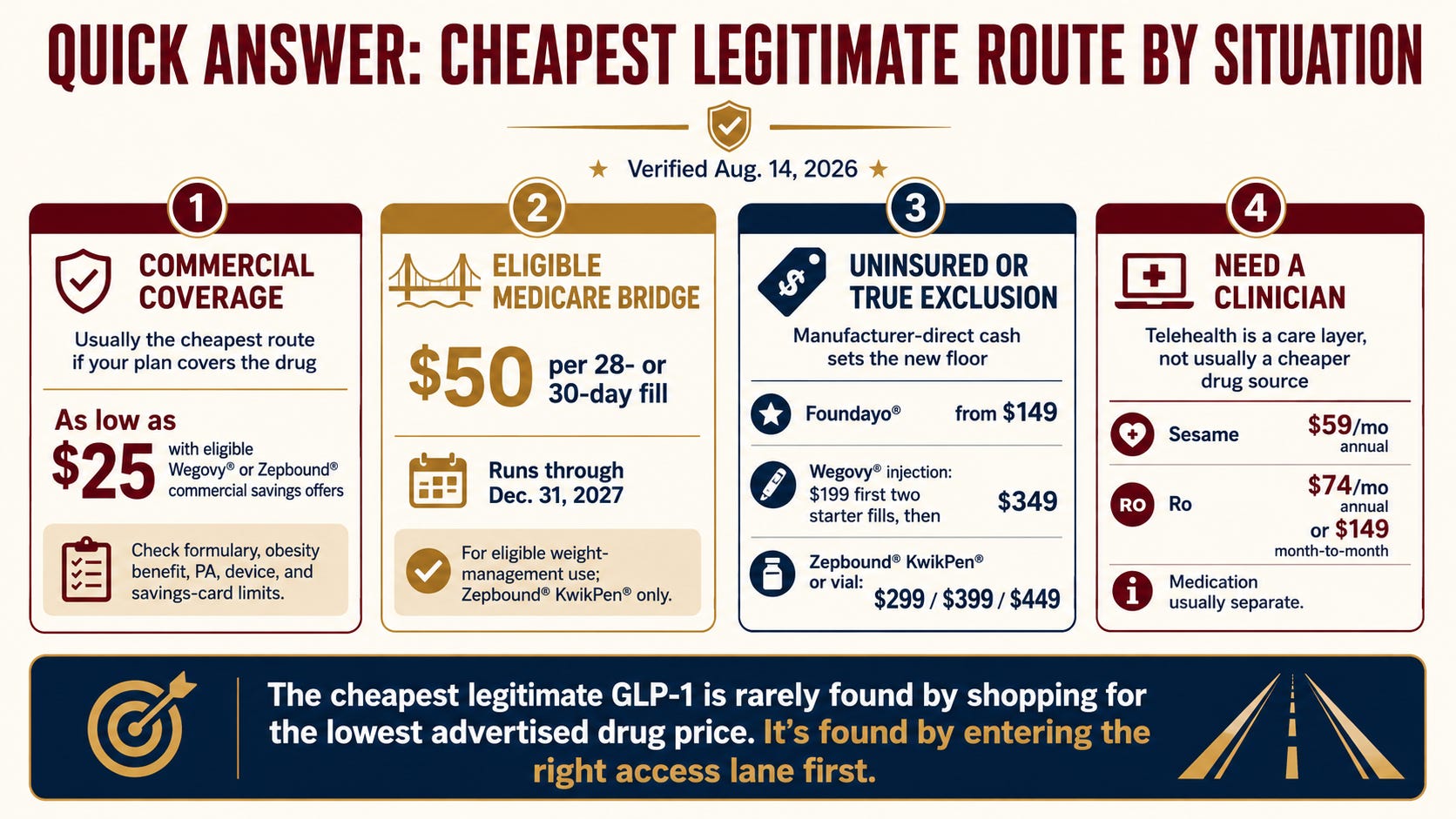
If you don’t want to read another 2,000 words about insurance and drug pricing, here’s the basic roadmap:
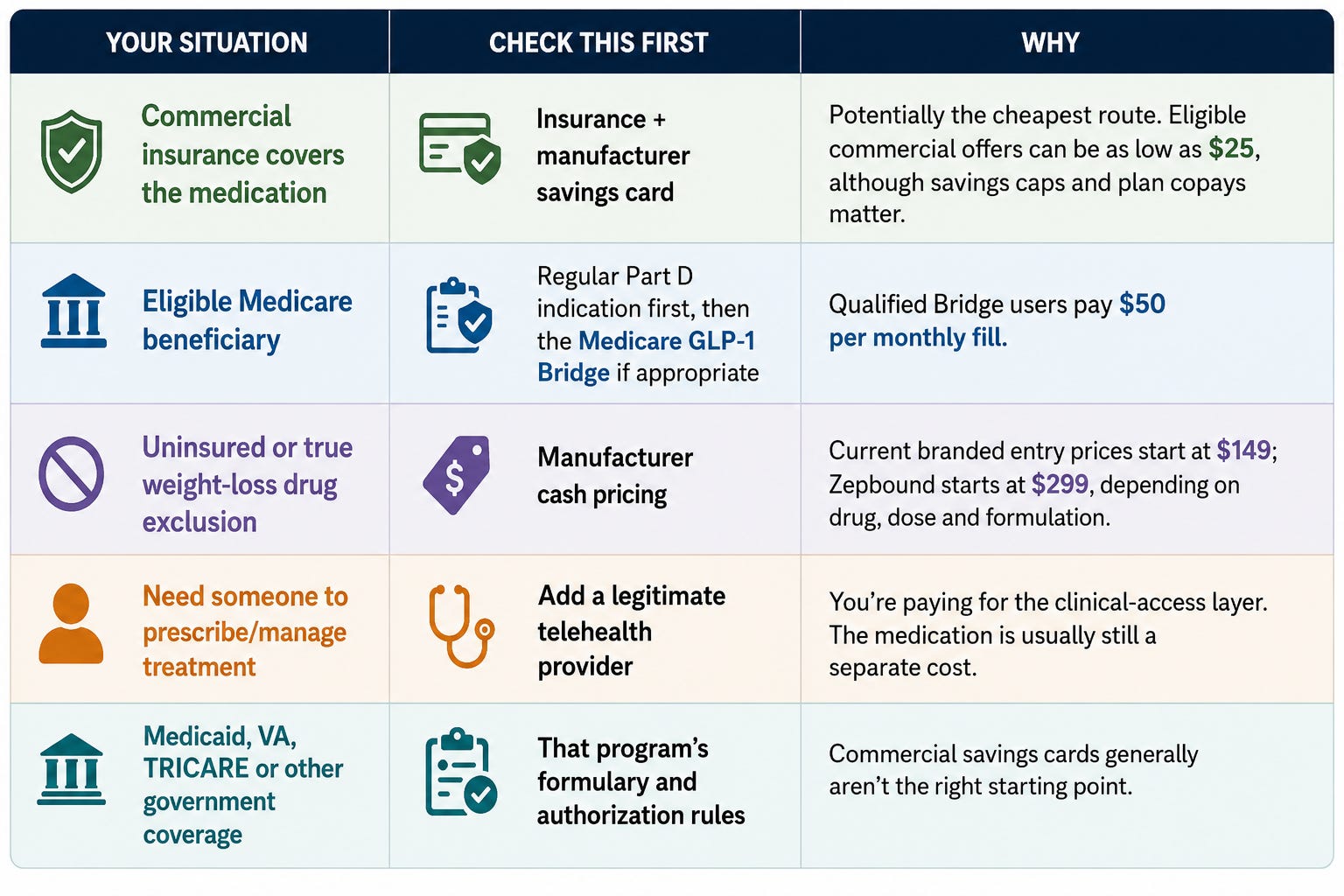
That’s the short version.
Now let’s make sure the “cheap” option you’re looking at is actually cheap.
Start With the Lane You’re Already In
If You Have Commercial Insurance
Don’t start at a telehealth website.
Start with your insurance.
Before paying cash, find out:
Is the medication on the formulary?
Does your plan actually include obesity-drug coverage?
Is prior authorization required?
Does the plan require a particular pharmacy or formulation?
If the medication is covered, this can still be the cheapest legitimate route by a wide margin.
Novo Nordisk’s current Wegovy savings offer, for example, can bring an eligible commercially insured patient’s cost down to as little as $25 per monthly prescription.
But here’s the fine print that matters:
The manufacturer savings benefit is capped at $100 per one-month fill.
So if your insurance leaves you with a $400 copay, the words “as little as $25” do not magically turn that bill into $25.
That’s why I keep coming back to the same principle:
Find out what your insurance actually pays before abandoning it.
The same basic caution applies to Zepbound. Lilly currently advertises pricing as low as $25 for certain eligible commercially insured patients, but the terms depend on coverage status and product presentation.
If you’ve already confirmed that your plan completely excludes weight-loss medications, that’s different.
Now the cash market becomes much more interesting.
If You Have Medicare
Medicare has two very different lanes now.
If the medication is being prescribed for an indication that ordinary Part D can cover, start there.
If it is being prescribed for weight management and you meet the plan and clinical requirements for the Medicare GLP-1 Bridge, the Bridge should be investigated before you start spending hundreds of dollars in cash.
Eligible beneficiaries currently pay:
$50 per 28- or 30-day fill.
That’s extraordinarily inexpensive compared with the private cash market.
But the Bridge has its own rules. It runs through December 31, 2027, the $50 does not count toward Part D true out-of-pocket spending, Extra Help doesn’t reduce it, and Zepbound is covered through the Bridge specifically in the KwikPen formulation—not the single-dose vial or traditional single-dose pen.
I’ve already gone much deeper into those rules in my separate Medicare GLP-1 Bridge guide.
The important point here is simpler:
If you qualify for the $50 Bridge, don’t pay $300–$500 cash before you’ve investigated it.
If Your Insurance Doesn’t Help
This is where the market has changed dramatically.
For years, “insurance doesn’t cover it” often meant staring at a pharmacy price somewhere around four figures.
Manufacturer cash programs have changed that.
And in my opinion, this is one of the most important developments in legitimate GLP-1 access.
Manufacturer Cash Pricing Has Set a New Floor
Here are the principal branded cash prices I found.
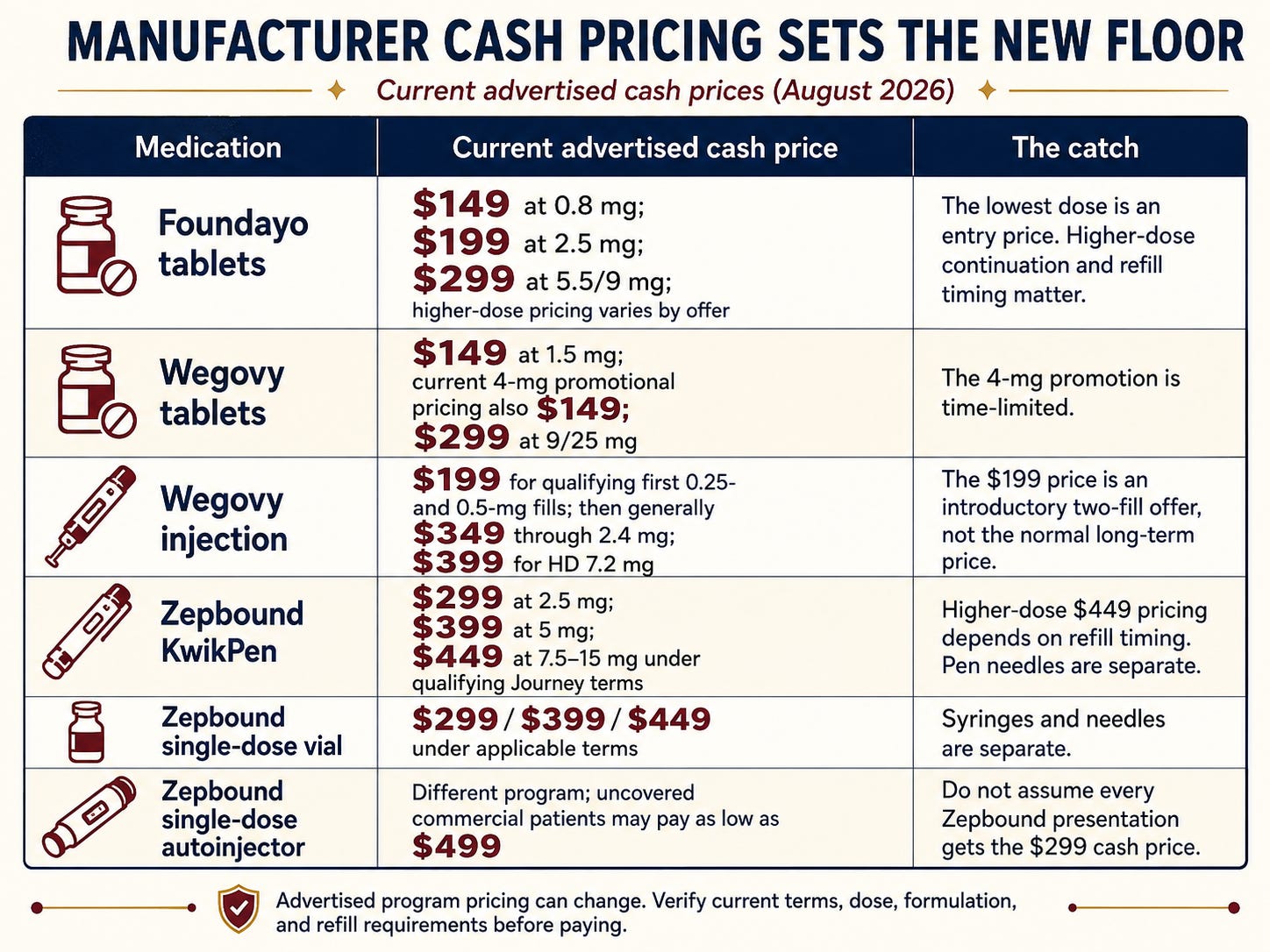
These aren’t generic overseas products or mystery “research” vials.
These are manufacturer products obtained through legitimate prescribing and dispensing channels.
That distinction matters.
Don’t Get Fooled by the Starter Price
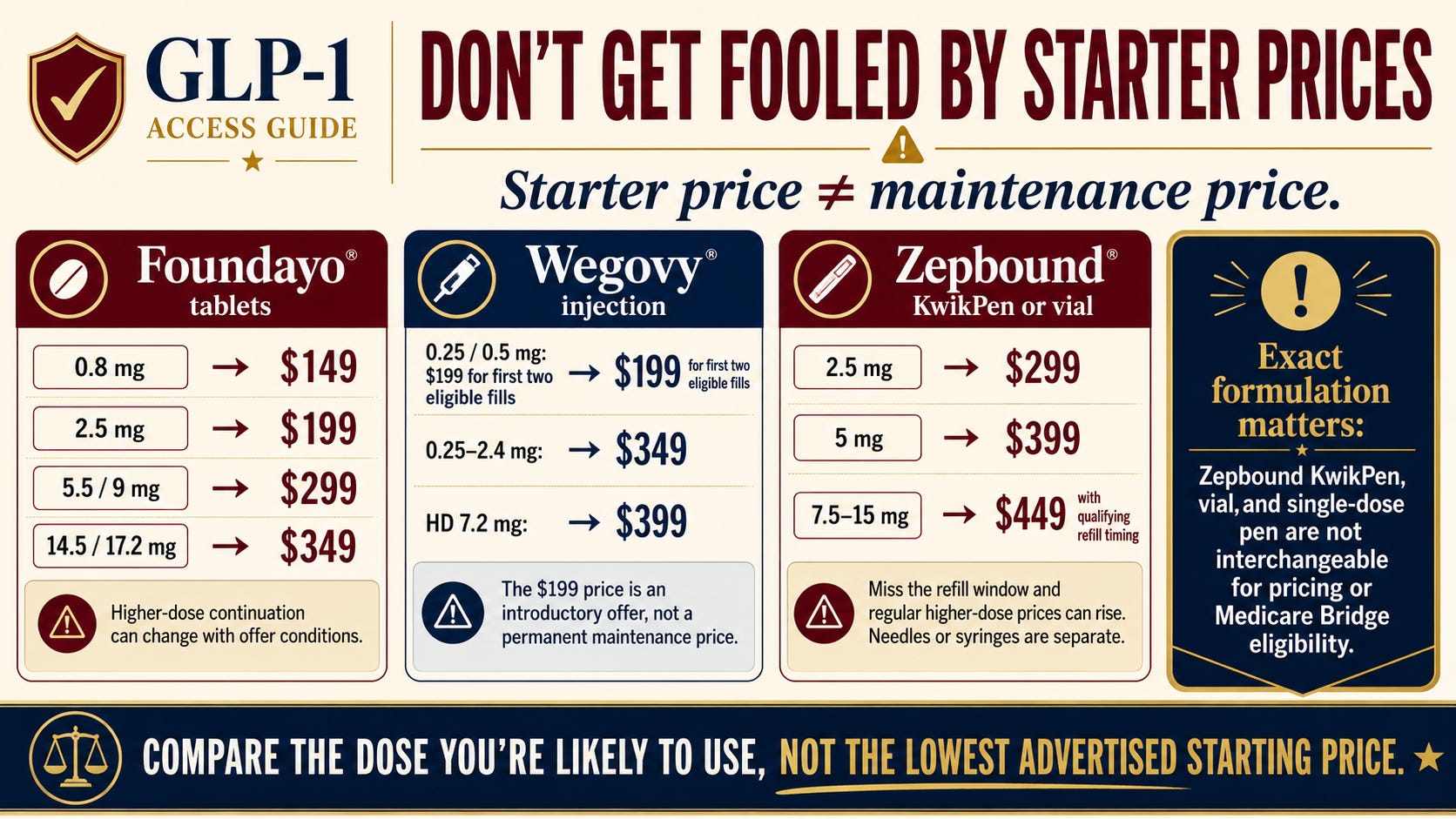
This is probably the single biggest trap in GLP-1 price advertising.
You see:
Zepbound — $299/month
Great.
Except Zepbound 2.5 mg is a starting dose, not an approved maintenance dose.
Move to 5 mg and the current manufacturer cash price becomes $399.
Move into the higher doses and the Journey price can be $449 if you continue meeting Lilly’s refill requirements.
Miss the qualifying refill window and the price can rise substantially. The research found current regular prices of $499 at 7.5 mg and $699 at 10, 12.5 and 15 mg when the Journey offer isn’t maintained.
Wegovy has the same problem in a different form.
That $199 injection price sounds fantastic.
And it is.
But it’s currently an introductory price for the first two eligible starter-dose fills.
After that, the general self-pay price is $349 through the standard injection doses, with Wegovy HD priced higher.
So here’s the rule I would use anytime you compare GLP-1 prices:
Never compare starter prices with maintenance prices.
Compare the dose you’re actually likely to use six months from now.
That’s the number that matters to your budget.
Do You Already Have a Prescriber?
This one surprised me.
A lot of people treat telehealth companies as if they’re another source of cheaper medication.
Usually they’re not.
They’re a clinical-access layer.
If you already have a physician or other appropriate clinician who will prescribe and monitor treatment, going directly through the manufacturer cash pathway may put you very close to the real medication cost.
If you don’t have a clinician, then a telehealth program may be extremely useful.
But now you need to add that fee to the medication.
Here’s what some of the major programs were advertising when I checked:
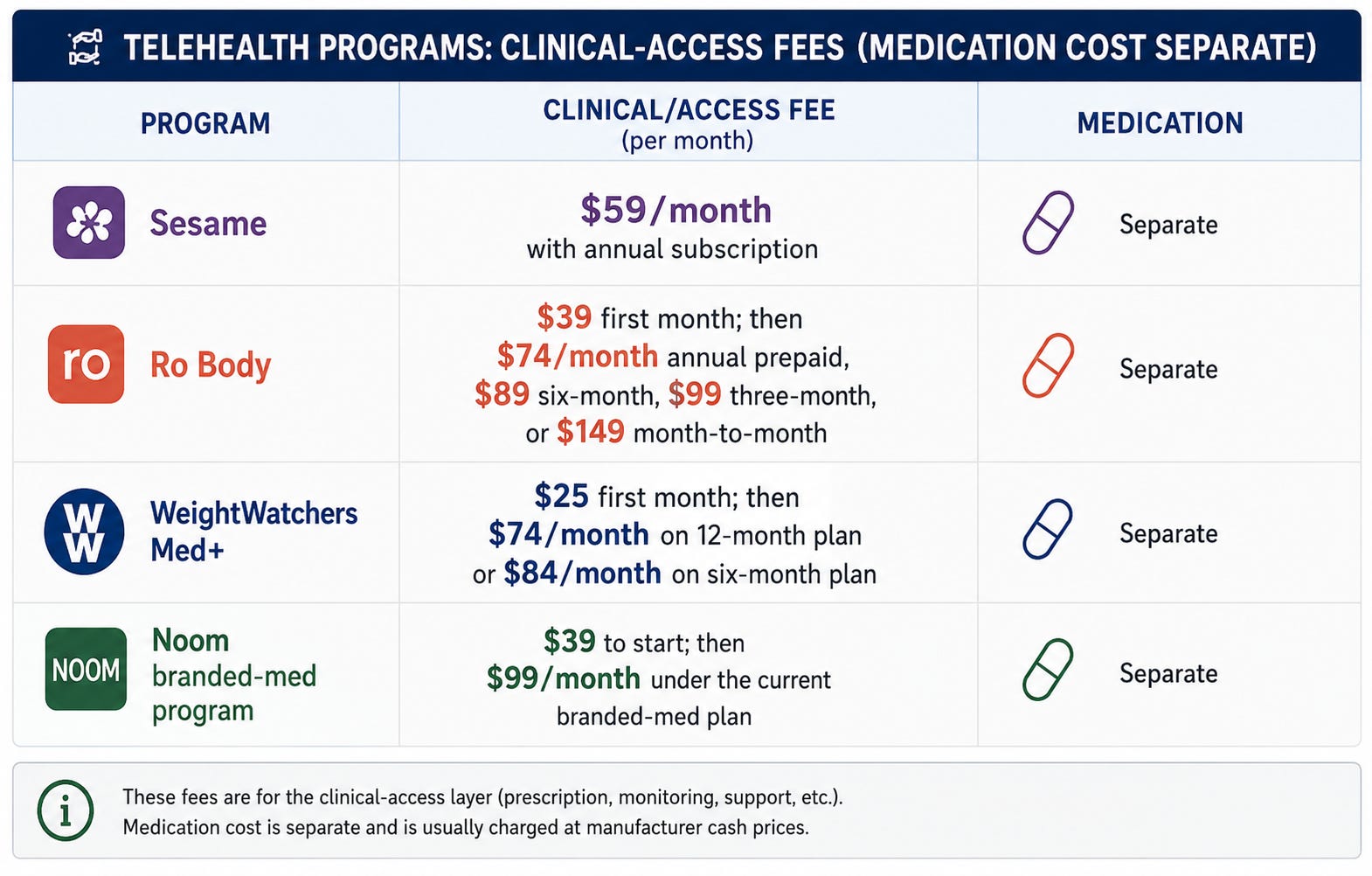
The useful comparison is not:
Ro versus LillyDirect.
It’s:
Manufacturer medication through my existing clinician
versus
the same or similar manufacturer medication price + $59, $74, $99 or $149 every month for clinical access and support.
Ro actually says its current branded cash prices match LillyDirect and NovoCare pricing.
That doesn’t make telehealth a bad deal.
Quite the opposite.
For someone who needs a prescriber, monitoring, laboratory work, insurance assistance or the convenience of managing everything online, that monthly fee may be money very well spent.
Just understand what you’re buying.
You’re usually buying care—not a secret cheaper supply of Zepbound.
What “All-In” Can Actually Look Like
Here’s an example using Zepbound KwikPen 5 mg.
Current manufacturer cash price:
$399
Now add the access layer.
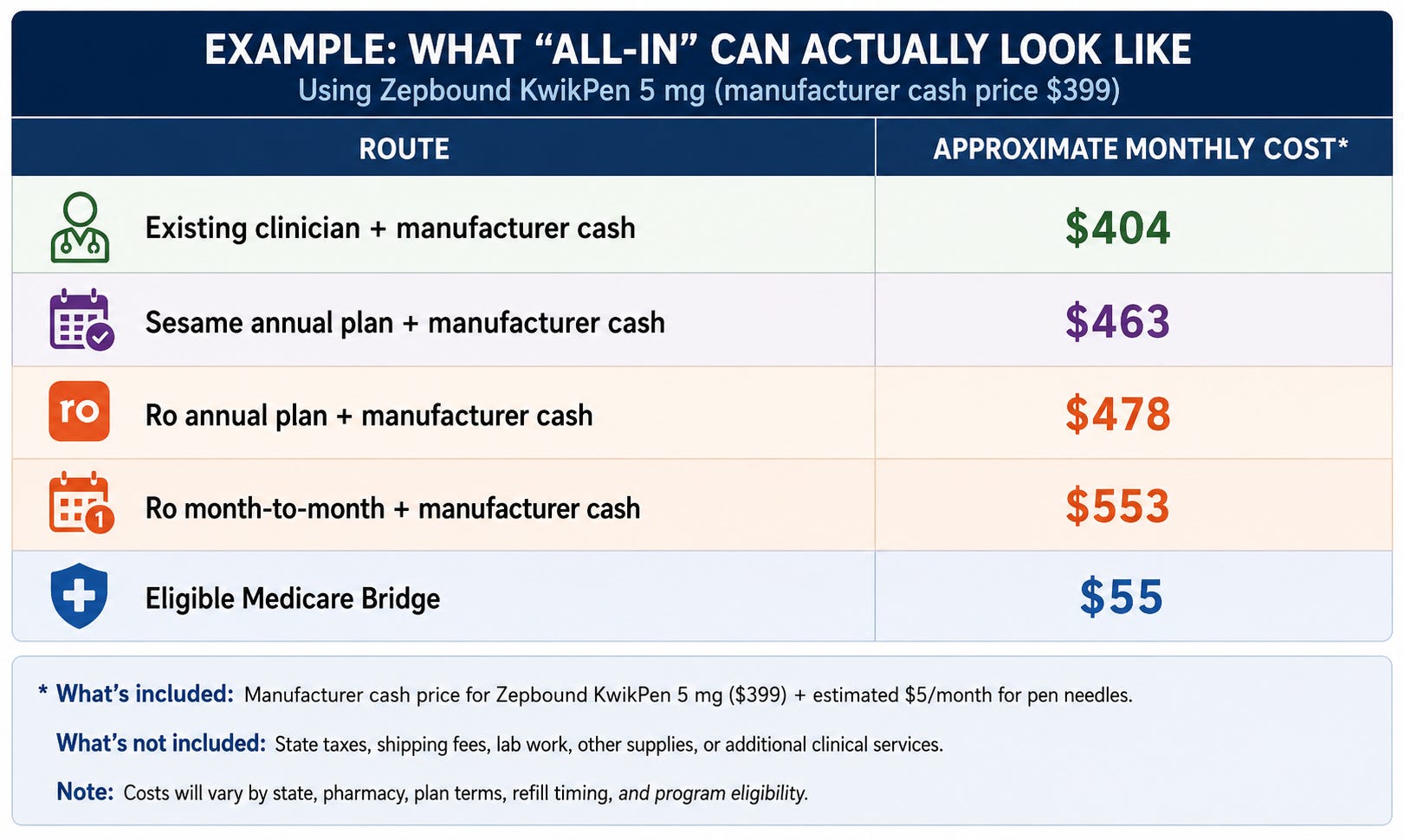
*The research model adds $5 per month as an illustrative allowance for separately purchased pen needles. That’s an assumption for comparison—not a national needle price. Existing-clinician cost also assumes no additional office charge that month.
The point isn’t whether your exact number is $463 or $478.
It’s this:
The exact same medication can become a completely different financial problem depending on how you access it.
The research model found representative telehealth-plus-medication combinations ranging from roughly $208 to more than $600 per month, while traditional undiscounted retail cash prices for major injectable brands can still reach four figures.
That’s why shopping only by the medication’s advertised price misses half the equation.
“Retail,” “Mail Order” and “Specialty Pharmacy” Don’t Tell You the Price
Another thing that became clear while researching this:
Where the box comes from isn’t necessarily what determines what you pay.
A local retail pharmacy can process a manufacturer-linked cash program.
A mail-order pharmacy can process an insurance benefit.
A specialty pharmacy may simply be the pharmacy your insurer requires.
Manufacturer self-pay may bypass insurance completely.
So I wouldn’t assume:
Mail order = cheap.
or:
Retail = expensive.
The better question is:
What payment program is this prescription being processed through?
Insurance?
A manufacturer savings card?
Manufacturer self-pay?
The Medicare Bridge?
Pure retail cash?
Those are different transactions even if the medication ultimately comes from a familiar pharmacy counter.
Novo Nordisk, for example, specifically says its Wegovy self-pay option runs outside insurance, meaning the cash payment doesn’t count toward the patient’s insurance deductible or maximum out-of-pocket spending. Medicare cash purchases outside Part D work similarly with respect to Part D true out-of-pocket spending.
That can matter a lot if you’re already spending heavily on healthcare.
Exact Formulation Matters More Than It Should
This sounds like paperwork trivia.
It isn’t.
Take Zepbound.
You might reasonably think:
Zepbound is Zepbound.
From an access standpoint, that’s not always true.
There is:
Zepbound KwikPen
Zepbound single-dose vial
Zepbound single-dose autoinjector pen
Different programs can treat those differently.
The clearest example is Medicare.
The GLP-1 Bridge currently covers eligible Zepbound KwikPen products.
The single-dose vial and traditional single-dose autoinjector are not interchangeable Bridge products.
A patient can meet the clinical criteria, have the correct Medicare plan and still get rejected because the prescription was written for the wrong device.
That’s absurdly easy to miss.
It’s also exactly why I don’t think GLP-1 access can be reduced to a list of prices.
The fine print sometimes decides whether the price is available at all.
What About Manufacturer Patient-Assistance Programs?
This is another place where generic “save money on GLP-1s” advice can waste people’s time.
You’ll often see:
“Apply for the manufacturer’s patient assistance program.”
That sounds great.
Except the medication actually has to be in the program.
Lilly Cares’ current 2026 medication list does not include Zepbound or Foundayo.
Novo Nordisk’s current patient-assistance list includes Ozempic and other diabetes products, but not Wegovy.
So for the major obesity products in this article, the manufacturer cash programs are currently a much more actionable route than traditional patient-assistance programs.
And I would not treat Ozempic or Mounjaro as cheap obesity substitutes simply because a diabetes assistance program happens to cover them.
The indication matters.
The prescription matters.
The coverage rules matter.
We’re trying to make the legitimate path easier—not create a new workaround.
A Word About Compounding—and What I Mean by “Legal”
When I say the cheapest legal way to get a GLP-1, I’m not using “legal” as shorthand for:
“I found a website that accepts a credit card.”
There are different categories here.
FDA-approved manufacturer medication obtained through a legitimate prescriber and pharmacy is the cleanest category we’re comparing in this guide.
Compounded medication can also be lawful in appropriate patient-specific circumstances.
But compounded drugs are not FDA-approved, and FDA does not review them before marketing for safety, effectiveness or quality in the way it does an approved manufacturer product.
The shortage environment that supported widespread copying has also changed. FDA has declared the tirzepatide and semaglutide injection shortages resolved and has increased enforcement around mass-marketed non-approved GLP-1 products.
Grey-market “research use only” peptides are something else entirely.
FDA has reported fraudulent GLP-1 labels, sterility problems and other issues involving unapproved products.
My goal here isn’t to shame anyone who ended up outside the traditional system.
I’ve said this before:
The grey market is a signal.
People want these medications badly enough that they’re willing to find another path when the legitimate one fails them.
The answer, in my opinion, isn’t simply to make that alternative harder.
It’s to make the legitimate market easier to choose.
And the good news is that the gap is getting smaller.
A legitimate branded GLP-1 starting at $149, Zepbound at $299, or a Medicare pathway at $50 looks very different from the four-figure cash prices that helped create this market in the first place.
There’s still a long way to go.
But that’s progress.
Before You Pay for Anything
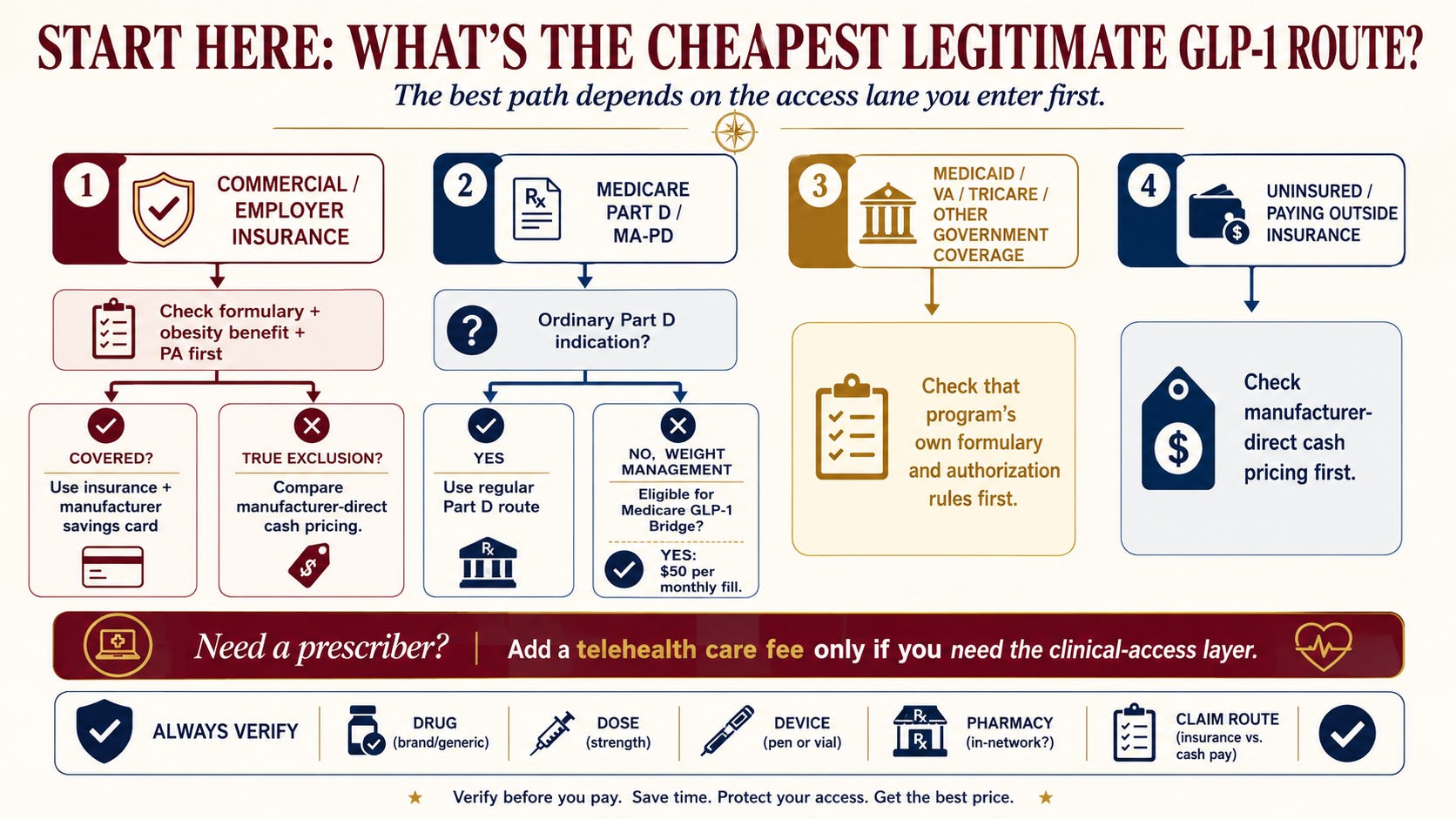
Run through this checklist first:
· Insurance: Is the medication actually covered? Is obesity treatment excluded? Is PA required?
· Indication: What condition is the prescription actually treating?
· Drug: Is it Wegovy, Zepbound, Foundayo or another product?
· Dose: Is the advertised price for a starter dose or the dose you’re likely to remain on?
· Formulation: Pen, KwikPen, vial or tablet?
· Pharmacy: Does your insurance or manufacturer program require a particular dispensing channel?
· Payment lane: Insurance, manufacturer savings card, Medicare Bridge, manufacturer cash or pure retail cash?
· Supplies: Are needles or syringes included?
· Refill deadline: Does missing a refill window change the price?
· Telehealth fee: Is medication included, or are you paying separately for clinical care?
· Commitment: Does the lowest monthly telehealth price require six or twelve months up front?
Those details are where a lot of the money disappears.
So, What Is the Cheapest Legal GLP-1?
There isn’t one answer.
But there is an order I would follow.
If commercial insurance covers it, work the insurance route first and then test the manufacturer savings card.
If you’re on Medicare, determine whether the prescription belongs in ordinary Part D or whether you qualify for the $50 GLP-1 Bridge.
If you’re uninsured or you’ve confirmed a true obesity-drug exclusion, check manufacturer cash pricing before paying ordinary retail cash or signing up for telehealth.
If you need a prescriber, add telehealth—but compare the care fee and the medication separately.
And every single time:
Check the exact dose and formulation before the prescription is filled.
That’s the real answer I came away with after digging through all of this.
The cheapest legitimate GLP-1 is rarely found by searching Google for the lowest advertised price.
It’s found by entering the right access lane first.
Insurance when insurance works.
The Medicare Bridge when Medicare qualifies.
Manufacturer cash when coverage fails.
Telehealth when you actually need the clinical access it provides.
There is enough friction in this system already.
My job with GLP-1 Access Guide is to do the legwork, figure out where those paths are, and make them easier for the next person to follow.
Don’t just make the grey market harder to use.
Make the legitimate market easier to choose.
Prices, promotions, eligibility requirements and program terms can change quickly. This guide reflects programs and pricing verified August 14, 2026. National advertised prices may not include state-specific taxes, supplies or other fees, and availability can vary by location. Always verify the current program terms, exact medication, dose and formulation before paying. This guide is educational and isn’t medical, legal or insurance advice.